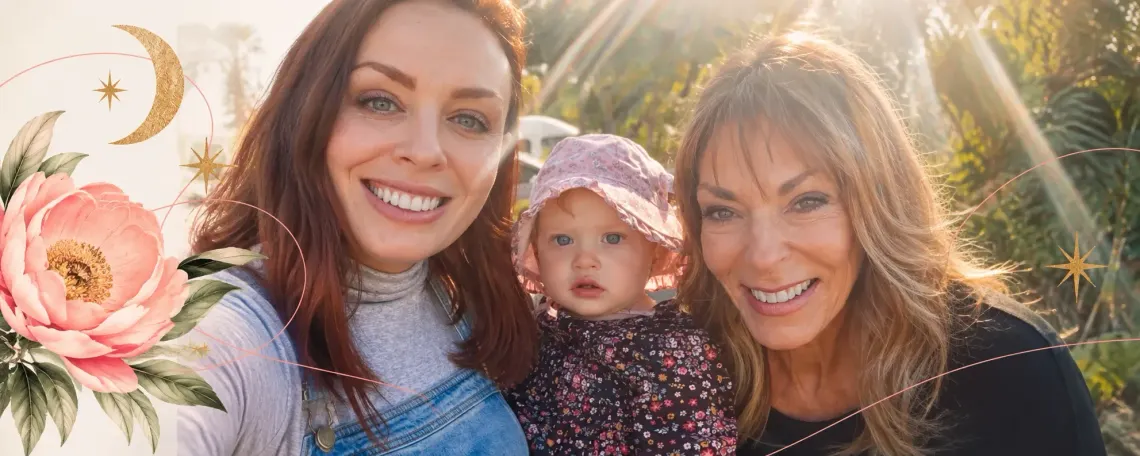
The few times my life has been flipped upside down, it’s happened with a simple phone call: usually in the afternoon, and usually on a perfect autumn day.
(I’ve always hated phone calls, but I hate perfect autumn days now too.)
This phone call came in early March 2022.
Heavily pregnant with my second baby, a little girl, I was mostly au fait with motherhood by this point, though that hadn’t always been the case. I’d had my first baby, Jimmy, two and a half years earlier and struggled with being a mum in those early days. Juggling a growing business and a little baby who hated sleep, I spent months, then years, fraying at the edges.
Thankfully, my mum had been there, just as she always was.
Every afternoon since Jimmy’s birth, armed with a smile and usually freshly puréed veggies too, my mum would show up at lunchtime to walk our little Jimmy up and down the beach, feed him in the highchair and give me a chance to work.
She relished her role as “Nansy,” and the bond between the two of them was so tight.
Besties, they were.
This particular afternoon was just like every other. I worked in one room; she sang to Jimmy and got him ready for his walk in the other. Until it wasn’t.
That afternoon, the phone rang and our entire lives crumbled. I heard the muffled conversation, and I knew. Somehow, I just knew. The strained tones. Her face. It wasn’t good.
A week later, we were sitting with the oncologist.
Primary peritoneal cancer, he said: a gynaecological cancer very similar in nature (and treatment) to ovarian cancer.
We’d never heard of it, and anyway, after a hysterectomy at 42, she didn’t even have ovaries anymore.
It didn’t matter, apparently. The cancer had likely started in her fallopian tubes, spread to a little piece of ovarian tissue still hanging around, then moved into her peritoneum, a cellophane-like wrapping that lines the abdominal cavity.
There’d been no symptoms until, a couple of weeks earlier, her belly had felt bloated and sore.
“Ascites,” said the oncologist. “It’s fluid build-up in your tummy. Common with more, er, advanced cancer.”
Is this it? I wanted to shout. Will I lose my beautiful mum, my everything? When?
I didn’t say that, though. It would have been too painful, for her and for me.
Instead, I asked what stage the cancer was. His answer told us everything we were both wondering anyway.
“Stage 4,” he said. He looked at his notes. “Actually, 4B. Come in next week. We have an information session to help you through.”
The info session was a pamphlet and a tired PowerPoint in a small room with fluorescent lights. There was a small group of us: a couple in their sixties, a woman in her forties or so, alone. And us.
The session was typical of the care that followed. Formal. Barren.
“You’ll lose your hair,” they said. We went wig shopping that afternoon.
“Everyone’s prognosis is different,” they said. Only we’d Googled, and they didn’t look so different. The survival statistics for peritoneal and ovarian cancers are devastatingly slim across the board.
And finally: “We’ll schedule your first round of chemotherapy for next week.”
And so the merry-go-round began.
Anyone who has supported a loved one closely through “the process,” or who is going through it now (you are amazing), will know what I mean.
The weekly chemo appointments. The aftermath: a day or two of “zing” from heavy medication, followed by four or five of bed rest, bloated extremities, nausea, sickness. The loss of feeling in fingers and toes. The hair falling out in clumps, and the loss of identity that follows. The sudden illnesses and hospital visits where you wonder, is this it? The excruciating open surgeries. The quiet nights wondering what’s to come. The not knowing. The knowing. All of it.
I feel blessed to have supported my mum through her most difficult days, just as she supported me my entire life. I had a front-row seat to every appointment, every surgery, every false hope.
I saw it all. And I saw her.
My mum was always the toughest, but through those times? I’ve never seen anyone so resilient, brave and heart-stoppingly courageous.
“You don’t really have a choice, do you?” she told me, smiling. Always smiling.
But of course, I saw the fear too. It was quiet, spoken aloud just once or twice, and otherwise present only in little flashes whenever the next piece of bad news arrived.
I felt it too.
The fear that she wouldn’t get to see Jimmy every day, or watch my new little girl grow up, or have the energy to walk the beach path anymore. The fear that despite the little hopes, it could all come crashing down at any time. The lingering wonder whether today was her last July day, or summer day, or Christmas Day. The fear that this, all of this (the treatments, the sickness, the merry-go-round), was all that was left. Knowing that it was. Hoping against hope that it wasn’t.
I lost my mum on 2 May 2024, two and a bit years after her diagnosis. It was a few days short of both World Ovarian Cancer Day and Mother’s Day.
I miss her. Those three words feel like an understatement, but there aren’t really words for how I feel anyway.
I’m not sure what’s worse: watching the person you love most experience pain every single day, or navigating the pain of not having them by your side, not ever again, for the rest of your life.
Of course, it’s both.
The truth is, losing a beloved parent changes you. A few weeks after, I read somewhere that losing your mum feels like wanting to go home and knowing you never can again. That’s it. It eats through the very fabric of your being and everything you hold true. It rips your security blanket away.
I’m sad for me, but more than that, I’m sad for her.
My mum didn’t get to see my little boy start school last year, or my little girl turn three, then four. She doesn’t get to come shopping on Saturdays anymore, or walk to the park with us, or enjoy the rest of the golden years she savoured so much.
She wasn’t ready to go. She told me so.
And for that, I’m not just sad. I’m angry.
Every woman should be.
Here’s why
This isn’t just about my beautiful mum, or about me.
Every single day in Australia, we lose three women to ovarian cancer. (Her peritoneal cancer was always put in the same bucket; its cells behave the same way.) Ovarian cancer is Australia’s deadliest gynaecological cancer, and in cancer circles it’s known as the “wrong cancer” to get.
The doctors and nurses all know how it starts: usually diagnosed at an advanced stage, because there’s no screening test. They know how it goes: treatment options that haven’t fundamentally changed since the early 1990s. And they know how it ends: one of the poorest prognoses of any cancer, thanks to chronic underfunding.
I could always see it on the faces of the staff in the chemo ward when they read my mum’s cancer type. The look they gave us. The knowing. It was never good.
Around 70% of ovarian cancers are found at stage three or four, when survival odds are among the lowest of all cancers.
These are the precious lives of our mums, sisters, wives, daughters and friends. These are our precious lives.
It’s not okay.
Yet because of chronic underfunding, we’re not giving ourselves and the people we love the fighting chance they deserve. Without action, more than 2.2 million women worldwide will die from ovarian cancer over the next 10 years. [check]
The only good news in knowing that? It doesn’t have to be “just the way it is.”
There’s one key that can change the story for millions of women: research funding. Research funding can give women the more my mum deserved. The more every woman with ovarian and related cancers deserves.
1. An early detection test
My mum found out she had cancer at stage 4B. She had no symptoms until it had progressed to a point where there was very little hope.
That should appal you. It did me.
That’s the norm for most women diagnosed. Right now, there’s no screening test for ovarian cancer: nothing you can book in for at your GP the way you do a cervical screen. The warning signs are quiet whispers that usually mirror period pain or digestive issues.
And no, a Pap smear doesn’t detect it. That’s for cervical cancer, yet so many women walk around thinking they’re covered when they very much aren’t.
That’s the hard truth, because ovarian cancer found early can be cured.
Professor Ford’s team is developing a blood test that picks up ovarian cancer DNA, and has been working toward a clinical trial in 2026. [check current status]
A day needs to come, and soon, when we can book a regular ovarian cancer screening with our GP, just like we do for cervical cancer.
2. Better treatment options
My mum had one treatment plan available to her: chemo, followed by major “debulking” surgery, followed by more chemo.
Is it a cure? No. There isn’t one.
These invasive treatments buy time, and usually not enough. More than half of women with ovarian cancer don’t live five years past diagnosis.
Ovarian (and peritoneal) cancer is hard to treat partly because there are so many subtypes. A week before my mum passed, she paid close to $10,000 for a report to see whether any personalised treatment options might be available to her.
It was offered far, far too late. She didn’t live long enough to find out.
We can do better, by funding research that lifts five-year survival rates for the next generation of women, through better testing and wider access to innovative personalised treatments.
3. For it to stop being a death sentence
The five-year survival rate for ovarian cancer in Australia is just 49%. That’s lower than the average survival rate for all cancers back in 1975. Ovarian cancer is decades behind.
Overall cancer survival has climbed to around 70% since then. Ovarian cancer has barely moved.
The World Ovarian Cancer Coalition estimates that if nothing changes, ovarian cancer deaths in our region will rise 81% by 2050. [check]
The culprit? Funding. It’s historically low, and always has been.
But! But! But! We can change it.
We did it with breast cancer. According to the Ovarian Cancer Research Foundation, breast cancer survival improved thanks to dedicated research, early detection tests, public campaigns and advocacy. Five-year survival for breast cancer is now 92%. It’s no longer the death sentence ovarian cancer still is.
We can do the same for ovarian cancer.
The goal? For every woman diagnosed to have that first terrifying meeting my mum had, only with a very different outcome:
- To be told their condition is treatable.
- To come home and tell their children it’s treatable.
- And to keep living, because it was caught early enough and treatment was personalised enough, thanks to the work done in the decade before.
That’s why I wrote this. I know for sure it’s possible to change the outcome for women, because we did it for breast cancer. This doesn’t need to be a death sentence. It still is, simply because it isn’t getting enough funding to drive the research already being done by incredible people.
How you can help
1. Look after yourself
Two things to know. First, a Pap smear or cervical screening test does not detect ovarian cancer. Second, there are symptoms to watch for.
- Abdominal bloating or increased abdominal size
- Abdominal or pelvic pain
- Appetite loss, feeling full quickly, or indigestion
- Needing to wee more often or urgently
- Changes in bowel habits
- Unexplained weight loss or gain
- Unexplained fatigue
If something is new, unusual for you, or won’t go away, see your GP.
I remember my mum skipping lunch with us one day because she had, in her words, “a bit of gastro.” I reckon that was the cancer, and that’s exactly the kind of nondescript thing we need to take seriously.
And advocate for yourself. Go to the doctor and make them listen. I think every woman has been dismissed by the healthcare system at one stage or another. (Like the time I passed out in a grotty public toilet at 21 from severe endometriosis pain, only for the policeman who found me to assume I’d overdosed and tell me to “just get up.” Yes, really 🙄.)
Don’t put up with it. If something feels off in your body, it probably is. Chase it up yourself, because no one else will.
2. Donate
Pledge a donation to the scientists working on an early detection test and on personalised treatments. There are two I recommend:
UNSW Gynaecological Cancer Research Group. Professor Caroline Ford and her team are developing an early detection test. Fashion label Camilla and Marc has been spearheading fundraising for their work, including a range with 100% of proceeds going to the research.
[Bookmark card: https://www.camillaandmarc.com/blogs/all/meet-the-research-team]
[link: donate or shop the range here]
If you can’t donate money and you live in Sydney, you may be able to donate blood to their research. [check this is still open]
Ovarian Cancer Research Foundation (OCRF). [link: Donate here] to fund a range of research initiatives.
This month, you can also join Frocktober: frock up for a day or the whole month, host a frock swap with friends, or simply donate. Every dollar goes to the OCRF’s research into early detection and better treatments.
[Bookmark card: frocktober.org.au]
3. If you run a business
I have a vision of small, female-owned (or female-supporting!) businesses banding together to fight this, each committing 1% or a tiny portion of monthly revenue to make a big collective difference. If that speaks to you, let me know. In the meantime, you can make a tax-deductible donation from your business using the links above.
A parting note
I get that lots of charities ask for donations, and all of them are worthy. Here’s why I’m asking you to consider this one.
I spent many, many days over those years in chemo wards full of beautiful women whose ovarian cancer was found too late, and for whom there were no more options.
Meanwhile, there are people working incredibly hard every day on an early detection test and better treatments. The only thing slowing them down is funding.
We got breast cancer survival to 92% with lots of people giving a little. We can do it with ovarian cancer too. With enough support, a screening test in the next few years is very, very possible.
PS: If you’ve read to the end, hit reply or leave a comment. I’ll send you a big virtual hug.
Join the conversation